

CHALLENGE ACCEPTED.
Scripture | Solitude | Prayer | GENEROSITY | Service | Fasting | Sabbath

Pursue Biblical Generosity.
Jesus talks often about money throughout the Gospels because of the powerful effect it has on our lives. In His most well-known sermon, the Sermon on the Mount, Jesus teaches, “Do not store up for yourselves treasures on earth, where moth and rust destroy, and where thieves break in and steal” (Matthew 6:19). Jesus isn’t cautioning us about stuff—He’s inviting us to examine what we treasure most. What He wants most is our heart—because when Jesus has our heart:
Fear loses its power
Greed loosens its grip
Contentment replaces need
Generosity becomes joyful
God’s mission moves forward
When He has our heart, we begin to see biblical generosity as a formative practice—something we intentionally pursue as we grow to become more like Jesus in partnership with God. Biblical generosity isn’t about a season, an emotion, charity, or an amount. Instead, it’s:
spiritual
a lifestyle
holy
worship
Scripture reminds us that biblical generosity is not done reluctantly or under compulsion, for God loves a cheerful giver. Where our treasure lies, our hearts will follow.
Generosity Challenge
-
Begin the formative practice of giving generously.
-
Give consistently rather than emotionally or seasonally.
-
Review your priorities and begin tithing as a non-negotiable practice.

Let’s Do This!
This challenge is designed to help you fall in love with reading God’s Word. Read the Bible slowly and attentively, with a heart eager to learn rather than a mindset driven by obligation.
Each daily challenge has three options. Choose which option you will pursue during our 90 days.
This Week’s Scripture Challenge (Feb. 2-6)
-
Monday, Feb. 2: Deuteronomy 8:10-18
Tuesday, Feb. 3: Proverbs 3:5-10
Wednesday, Feb. 4: Luke 12:13-21
Thursday, Feb. 5: 2 Corinthians 9:6-11
Friday, Feb. 6: Matthew 6:19-24
-
Monday, Feb. 2: Deuteronomy 8
Tuesday, Feb. 3: Proverbs 3
Wednesday, Feb. 4: Luke 12
Thursday, Feb. 5: 2 Corinthians 8-9
Friday, Feb. 6: Matthew 6
-
Monday, Feb. 2: Luke 23-24; John 1-2
Tuesday, Feb. 3: John 3-6
Wednesday, Feb. 4: John 7-11
Thursday, Feb. 5: John 12-15
Friday, Feb. 6: John 16-19
Jan. 26-30 Scripture Challenge
-
Monday, Jan. 26: Matthew 6:5-13
Tuesday, Jan. 27: Luke 11:1-13
Wednesday, Jan. 28: Philippians 4:4-9
Thursday, Jan. 29: Psalm 23
Friday, Jan. 30: John 15:1-11
-
Monday, Jan. 26: Matthew 6
Tuesday, Jan. 27: Luke 11
Wednesday, Jan. 28: Philippians 4
Thursday, Jan. 29: Psalm 23
Friday, Jan. 30: John 15
-
Monday, Jan. 26: Luke 1-5
Tuesday, Jan. 27: Luke 6-9
Wednesday, Jan. 28: Luke 10-14
Thursday, Jan. 29: Luke 15-18
Friday, Jan. 30: Luke 19-22
Jan. 19-23 Scripture Challenge
-
Monday, Jan. 19: Mark 1:29-39
Tuesday, Jan. 20: Psalm 46
Wednesday, Jan. 21: 1 Kings 19:1-13
Thursday, Jan .22: Luke 5:12-16
Friday, Jan. 23: Psalm 62
-
Monday, Jan. 19: Mark 1
Tuesday, Jan. 20: Psalms 46-47
Wednesday, Jan. 21: 1 Kings 19
Thursday, Jan. 22: Luke 5
Friday, Jan. 23: Psalms 62-63
-
Monday, Jan. 19: Matthew 23-27
Tuesday, Jan. 20: Matthew 28; Mark 1-3
Wednesday, Jan. 21: 1 Mark 4-8
Thursday, Jan. 22: Mark 9-12
Friday, Jan. 23: Mark 13-16
-
Monday, Jan. 12: Psalm 1
Tuesday, Jan. 13: Psalm 19
Wednesday, Jan. 14: Psalm 119:9-16
Thursday, Jan. 15: 2 Timothy 3:14-17
Friday, Jan. 16: Matthew 7:24-27
-
Monday, Jan. 12: Psalms 1-2
Tuesday, Jan. 13: Psalm 19
Wednesday, Jan. 14: Psalm 119:1-16
Thursday, Jan. 15: 2 Timothy 3-4
Friday, Jan. 16: Matthew 7
-
Monday, Jan 12: Matthew 1-5
Tuesday, Jan 13: Matthew 6-9
Wednesday, Jan 14: Matthew 10-14
Thursday, Jan 15: Matthew 15-18
Friday, Jan 16: Matthew 19-22
Jan. 12-16 Scripture Challenge
Go Deeper…
If you are interested in further study about the Bible, try these helpful resources:
Scripture Resources
-
Best for: Reframing why we read Scripture.
Best for:: People who need a reset in how they approach the Bible.
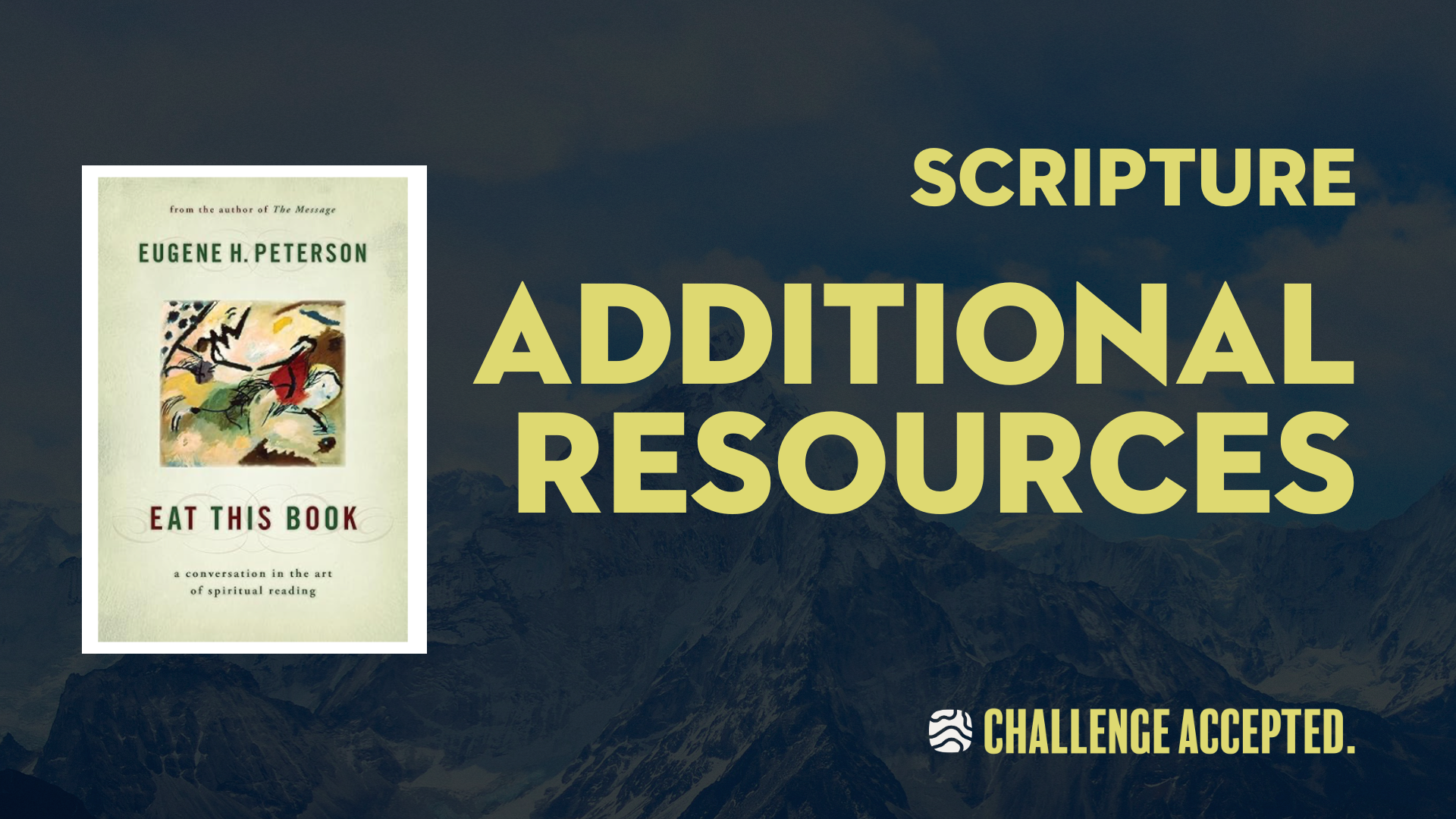
Peterson invites readers to move beyond skimming for information and instead to receive Scripture as nourishment—something to be eaten, internalized, and obeyed. This book reshapes posture more than technique and lays the spiritual foundation for everything else.
-
Best for: Understanding how the Bible works.
Excellent for: Individuals and small groups.
This free, video-based course helps readers see the Bible as a unified story with intentional literary design. It builds confidence, reduces intimidation, and equips people to read Scripture thoughtfully and patiently.
-
Best for: Practicing slow, formational reading (Lectio Divina).
Ideal for: Those ready to learn how to “eat” Scripture.
Mulholland offers one of the clearest and most pastorally grounded introductions to Lectio Divina—reading Scripture slowly and prayerfully so that it shapes who we are becoming, not just what we know.
-
Best for: Daily devotional guidance rooted in the gospel.
Great for: Those who want consistency and encouragement as they build a daily rhythm.
This daily devotional pairs short Scripture readings with gospel-centered reflection, helping readers stay grounded in grace rather than performance. Tripp consistently points readers back to Christ’s finished work and God’s ongoing mercy.
-
Best for: Addressing doubts about the trustworthiness of Scripture.
Best for:Skeptics, questioners, or those rebuilding confidence in Scripture.
One of Wes Huff’s most-watched talks, this presentation walks through manuscript evidence, textual transmission, and historical reliability of the Bible in a clear, accessible way. Huff speaks to skeptics with intellectual honesty and calm confidence, making this especially helpful for those wrestling with doubts or objections.
Why this resource matters:
-Directly addresses “Can I trust the Bible?”-Grounds faith in historical evidence, not blind belief.
-Helps remove intellectual barriers that prevent people from engaging in Scripture at all.

Pray in Solitude.
Prayer can happen anytime, anywhere—and it should. But prayer in solitude is an intentional, set-apart practice where we meet with God without distraction, performance, or hurry.
In this challenge, try shifting your viewpoint of prayer from transactional—asking God for things—to relational: a daily rhythm of listening to God, speaking honestly with Him, and being formed over time.
Jesus Himself regularly withdrew to solitary places to pray (Luke 5:15–16), reminding us that solitude is not optional for spiritual formation—it’s essential.
To help make prayer accessible, try a simple framework Jesus modeled in Matthew 6, summarized with P.R.A.Y.:
Pause – slow down and become present with God
Rejoice – remember who God is
Ask – bring your real needs and concerns
Yield – surrender control and trust God’s work within and around you
Prayer in solitude isn’t about perfection, long hours, or having the right words. It’s about availability. Even a few consistent minutes each day can become a sacred meeting place where God shapes our hearts, our desires, and our obedience
The invitation this week is simple:
Create space. Show up. Practice prayer as a relational rhythm.
Prayer Challenge
-
Practice prayer in solitude at least once per week.
-
Practice prayer in solitude 4+ times a week.
-
Read/listen to the additonal resources provided in the section below.
Go Deeper…
If you are interested in further study on prayer, try these helpful resources:
Prayer Resources
-
“How to Pray “is a raw, real, and remarkable how-to-guide on prayer for everyone―from the committed follower of Jesus to the skeptic and the scared.
-
Foster shows how prayer can move us inward into personal transformation, upward toward intimacy with God, and outward to minister to others.
-
Listen to this five-part series on the Lord’s Prayer, exploring its structure, core ideas, and historical background.

Solitude is a practice of prioritizing intentional alone time with God—free from distraction. What would it look like if we embraced the challenge of solitude and began to be transformed by listening to God distraction-free?
Create Space.
Choose one of the three challenges below to intentionally spend time alone with God.
-
10 Minutes of Solitude a day. No phone, No music, No screens.
-
Challenge A + 1 hour extended solitude per week.
-
Overnight Solitude Away (Retreat, Camping, Hotel, Ship the family off, etc.)
Solitude Challenge

Go Deeper…
If you are interested in further study about solitude, try these helpful resources:
Solitude Resources
-
Author Ruth Haley Barton invites you to meet God deeply and fully outside the demands and noise of daily life.
-
Iona House in Placerville, CA was created specifically to offer separation from ordinary life in order to make possible an experience of intensification of your identity in Christ.
Learn more about Iona House solitude retreats.